GLOBAL REACH

CM
🇺🇸
🇨🇦
🇪🇸
🇪🇺

50+ Countries • 24/7 AI Support

Part 3 Hero

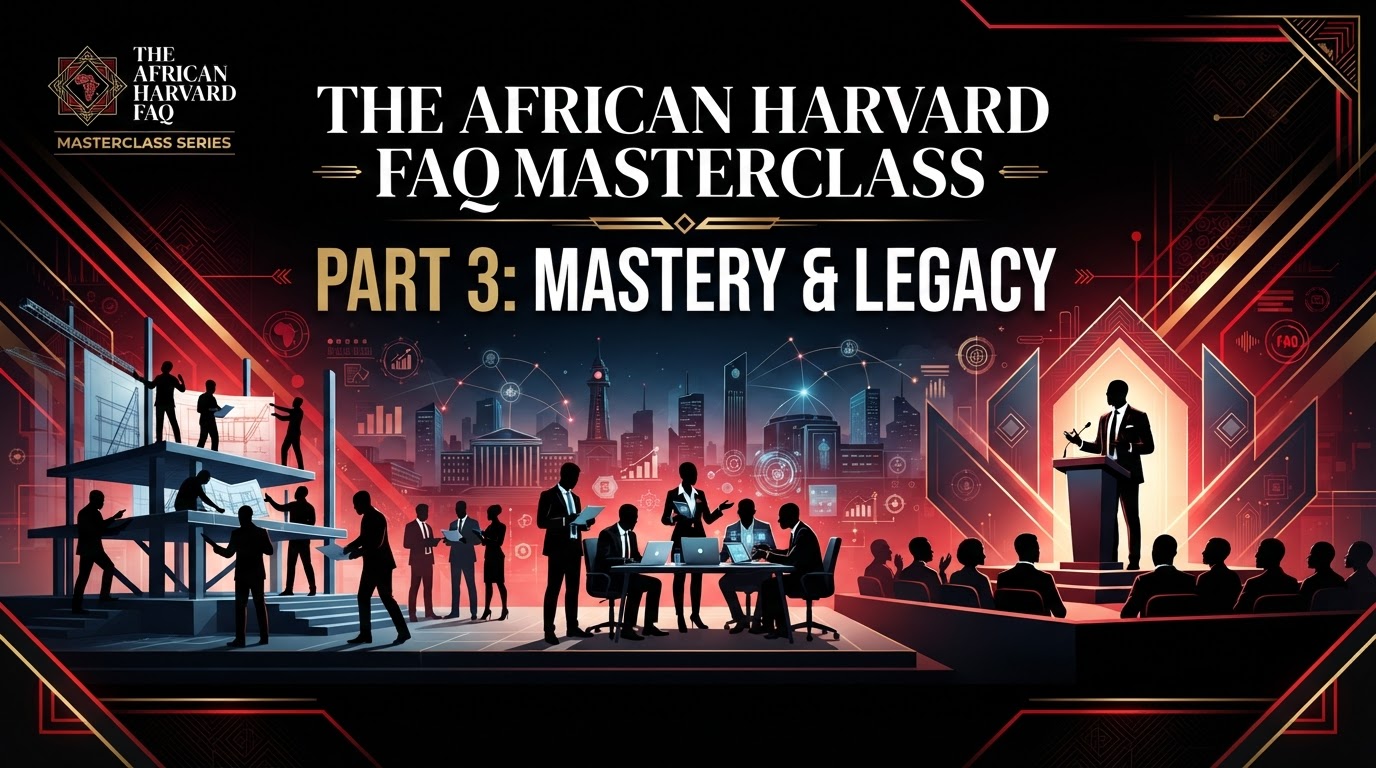
PART 3: MASTERY & LEGACY

The African Harvard FAQ Masterclass

Final answers on creating lasting impact, building your legacy, and becoming a force for African transformation.

← Part 1: Foundations • Part 2: Solutions & Strategy • Part 3: Mastery & Legacy

24/7 AVAILABLE

The AI Tutor Guides Your Legacy

The final frontier: understanding your role in creating systemic change, building a legacy that outlasts you, and becoming a thought leader in African transformation. Our 24/7 AI Tutor is ready to help you design your ultimate impact.

Ask the AI About:

  • → How to build a legacy that lasts generations
  • → Becoming a thought leader in your field
  • → Creating systemic change in your community
  • → Building global influence from Africa
  • → Scaling your impact across nations
  • → Your unique contribution to African transformation

Frequently Asked Questions - Part 3

Root Cause Analysis

What is the biggest problem in Africa today?

If I had to name ONE problem that underlies all others, it would be this: Africans have been taught to not believe in themselves.

The Root Problem:

Not poverty. Not lack of resources. Not geography. The problem is psychological: millions of Africans believe their solutions must come from outside Africa. They believe their knowledge is less valuable. They believe their voice doesn't matter.

This belief creates paralysis. People wait for governments, wait for foreign aid, wait for NGOs. They never build their own solutions.

The Solution: When Africans believe in themselves—in their knowledge, their creativity, their capacity to solve problems—Africa transforms. The African Harvard exists to restore this belief.

Opportunity Mapping

Which African country is best to live in?

This depends entirely on your goals. But here's the truth: the "best" country is the one where YOU can do your best work.

For Tech & Entrepreneurship: South Africa, Kenya, Nigeria, Rwanda offer thriving startup ecosystems and access to venture capital.

For Education & Teaching: South Africa, Ghana, Uganda have strong existing education systems you can build upon.

For Affordability & Calm: Rwanda, Botswana, Namibia offer low cost of living and political stability.

For Scale & Opportunity: Nigeria (population), Egypt (strategic), Kenya (regional hub) offer massive markets.

The Real Answer: Your location matters less than your commitment. You can build global impact from any African country. Choose based on your mission, not just comfort.

Systemic Understanding

What is the importance of education in Africa?

Education is not optional in Africa. It is the foundation of everything.

Why Education Is Critical:

  • Breaking Poverty: Education is the primary escape route from generational poverty
  • Economic Growth: Every year of education adds ~0.37% to GDP growth
  • Health: Educated populations have better health outcomes and lower mortality
  • Democracy: Education creates informed citizens who demand accountability
  • Global Competitiveness: Africa can only compete globally through educated talent
  • Personal Liberation: Education gives individuals agency over their own lives
Health & Wellbeing

What is the #1 cause of death in Africa?

The #1 preventable cause of death in Africa is lack of access to clean water and basic healthcare.

Key Health Challenges:

  • • Infectious diseases (malaria, tuberculosis, HIV remain leading causes)
  • • Maternal and child mortality (preventable with basic healthcare)
  • • Malnutrition and stunting in children
  • • Road traffic accidents and injuries (growing)
  • • Non-communicable diseases (diabetes, heart disease—increasing)

The Opportunity: Most of these deaths are preventable through education, basic infrastructure, and access to healthcare. This is where entrepreneurs and social innovators can create massive impact.

Quality Assessment

How is the quality of education in South Africa?

South Africa has two parallel education systems: one excellent, one struggling. Quality depends entirely on which system you're in.

High-Quality (Wealthy Schools):

  • • University entrance rates: 80%+
  • • International benchmark performance
  • • Well-trained teachers
  • • Good infrastructure

Lower-Quality (Under-Resourced):

  • • University entrance: 10-15%
  • • Below international benchmarks
  • • Teacher shortages
  • • Limited infrastructure

The Reality: The gap is not small. It's one of the most glaring inequalities in global education. Parallel learning systems are essential.

Thought Leadership

How can I become a thought leader in African transformation?

Thought leadership is not a title or a platform. It's earned through consistent demonstration of insight, integrity, and impact.

The Path to Thought Leadership:

1. Develop Deep Expertise — Choose a specific area (education, health, finance, agriculture, tech). Become an expert. Not just knowledgeable—an expert.

2. Document Your Journey — Write, speak, create content. Share your insights. Your journey becomes your proof.

3. Solve Real Problems — Don't just theorize. Actually solve problems in your field. Build something. Show results.

4. Build Relationships — Connect with other thinkers, leaders, activists. Collaboration elevates everyone.

5. Stay Authentic — The internet is full of fake experts. Your authenticity is your greatest asset. Never compromise it for followers or credibility.

Your 12-Month Thought Leadership Plan:

  1. Months 1-3: Choose your focus area. Research deeply. Find your unique angle.
  2. Months 4-6: Start creating content. 1 article/video per week on your topic.
  3. Months 7-9: Build a community. Engage with others in your space. Collaborate.
  4. Months 10-12: Synthesize learnings. Publish your definitive work on your topic.
Legacy Building

How do I build a legacy that lasts generations?

Legacy is not about fame or money. It's about impact that outlives you. Here's how to build it.

The Four Pillars of Lasting Legacy:

1. Systems, Not People

Build systems and institutions that outlive you. Train people who continue your work. Create processes that can be replicated.

2. Knowledge Transmission

Write books, create courses, document your knowledge. Make it freely available. Knowledge multiplies when shared.

3. People Development

Mentor the next generation. Find people with greater potential than yourself. Help them become bigger than you.

4. Mission Clarity

Be absolutely clear about your mission. Write it down. Make it bigger than yourself. Attract people who believe in it.

Remember: The most powerful legacy is the people you develop. The African Harvard exists because Bisong Simon invested in creating a system and training people to carry it forward. That's legacy.

Final Reflection

What is my unique contribution to African transformation?

This is the question that matters most. Not: "How do I get rich?" Not: "How do I become famous?" But: "What is MY unique gift?"

Discover Your Unique Contribution:

  1. Step 1: What problem breaks your heart? What injustice makes you angry? What need do you see that no one else is addressing?
  2. Step 2: What skills, experiences, and knowledge do you have? How do they connect to the problem you identified?
  3. Step 3: Who would benefit if you solved this problem? Describe one person specifically.
  4. Step 4: What is ONE action you can take THIS WEEK to move toward this?

The Truth: Africa doesn't need more people waiting for permission or waiting for perfect conditions. Africa needs YOU—right now—bringing your unique gifts to solve the problems only YOU can see the way YOU can solve them.

Your Declaration:

"I am enough. I have what it takes. My knowledge matters. My voice matters. My action matters. I commit to using my gifts to contribute to African transformation, starting today."

Your Next Steps

Knowledge without action is just theory. These are your action steps:

Connect With The African Harvard